
11th Floor, Chuangbo Industrial Park, 177 Tianchen Road, High-tech Zone, Jinan City, Shandong Province, China
Views: 0 Author: Site Editor Publish Time: 2025-10-06 Origin: Site


When HDMI cables stop, fiber keeps the video perfect — here’s how to pick the right HDMI optical transceiver. In professional AV environments where long distances, flawless image quality, and absolute reliability are non-negotiable, HDMI over fiber is quickly replacing copper HDMI cabling. Shandong Dongfang Communication Technology Co., Ltd., a trusted manufacturer in the optical communication industry, provides advanced solutions that make it possible to transmit uncompressed 4K video over kilometers of fiber. This article explores why fiber is chosen for demanding AV setups, how an HDMI video optical transceiver works, and what you should consider when selecting the right product for your installation.
Copper HDMI cables are fine for short runs — typically no more than 10 to 15 meters before signal degradation begins. Beyond that, the attenuation leads to blurry images, dropped frames, or complete signal loss. In large venues like stadiums, control rooms, or broadcast facilities, copper simply cannot cover the distance between sources and displays.
In addition to distance, copper HDMI cabling is highly vulnerable to electromagnetic interference (EMI). In environments packed with lighting systems, broadcast gear, or industrial machinery, noise can distort video signals. Ground loops are another issue: when equipment is spread across long distances and powered from different circuits, electrical grounding differences create hum or interference. Fiber optic cabling eliminates both problems since it is immune to EMI and does not rely on electrical grounding.
Modern AV isn’t just about connecting a projector to a laptop. Broadcast studios, live sports, and digital signage demand 4K resolution, HDR, and sometimes 120Hz refresh rates. These formats push data rates well beyond 18 Gbps. Traditional HDMI cabling struggles to carry such high bandwidth over distance. Fiber optic cabling, however, offers near-unlimited bandwidth and can transmit uncompressed ultra-high-definition video with no visible loss. For AV integrators planning for 8K or beyond, fiber ensures future-proof capacity.
At the heart of HDMI over fiber is the optical transceiver. An HDMI video optical transceiver converts the electrical HDMI signal into an optical signal for transmission over fiber, then converts it back to HDMI at the other end. The transmitter (Tx) sits near the video source — a camera, media server, or control system — while the receiver (Rx) is installed at the display or video wall. The light pulses carry the digital data with no interference, even over several kilometers.
This conversion is fully transparent to the AV equipment. The HDMI source and display see a standard HDMI connection, but the actual transport in between happens over fiber. For system installers, this means seamless integration with existing workflows, while unlocking distance and reliability advantages.
HDMI over fiber products generally come in two forms. One option uses SFP (small form-factor pluggable) optical modules in combination with media converters. These are modular, allowing integrators to swap optical modules to match singlemode or multimode fiber. The other option is dedicated HDMI extender units, where Tx and Rx are purpose-built devices with HDMI ports and integrated optics.
SFP-based solutions offer more flexibility and scalability for large systems, while extenders are often plug-and-play, ideal for straightforward point-to-point links. Both approaches rely on the same principle of converting HDMI signals to optical and back, but the choice depends on project complexity and the need for long-term expandability.
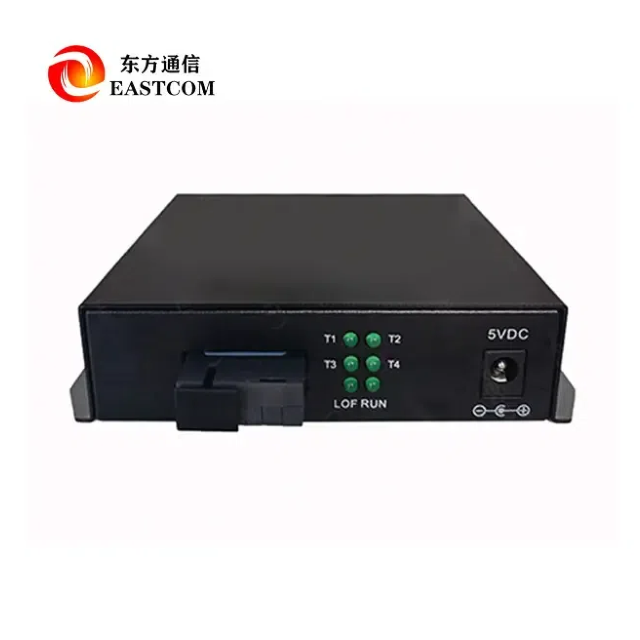
Not every HDMI optical transceiver supports the same video formats. For professional use, you need to confirm compatibility with 4K at 60Hz, HDR 10-bit color, and HDCP copy protection. Some products may only handle 1080p or may drop frames when pushed to high refresh rates. Shandong Dongfang Communication’s modules are designed to support uncompressed 4K/60 with full HDCP compliance, ensuring smooth playback for both broadcast content and protected media streams.
Latency is critical in live production, medical imaging, or interactive displays. Compressed HDMI-over-IP systems can introduce noticeable delay, which is unacceptable for real-time applications. HDMI video optical transceivers from Shandong Dongfang Communication transmit uncompressed signals with near-zero latency. For AV engineers, this ensures that lip sync is preserved and live feeds stay perfectly in time.
Fiber cabling comes in two types: multimode (OM3/OM4) and singlemode. Multimode fiber is ideal for short- to medium-distance runs within buildings, typically up to 300–500 meters. Singlemode fiber can carry signals for tens of kilometers, perfect for stadiums, campuses, or inter-building connections. Selecting the right HDMI optical transceiver means ensuring it matches your cabling. With Shandong Dongfang Communication’s product line, both multimode and singlemode options are available, giving system designers flexibility across projects.
Even with fiber, installation must be precise. Properly terminated connectors, clean fiber ends, and bend-radius control are essential. Dust or scratches on a fiber end face can prevent the optical signal from passing correctly, leading to intermittent dropouts. Always test links with optical power meters or built-in diagnostics before final commissioning.
HDMI optical transceivers typically require local power. For rack installations, ensure adequate power distribution units (PDUs) are in place. In field setups such as live events, consider whether the receiver will need power near the display. Some systems support USB or PoE power, but most require standard adapters. Rack mounting kits from Shandong Dongfang Communication simplify integration into control rooms, making systems easier to service and manage.
The strongest case for HDMI over fiber comes from real-world applications. In live sports broadcasting, cameras on the field need to send uncompressed 4K video to a central control room hundreds of meters away. Fiber handles the distance and bandwidth without introducing delay.
In digital signage, shopping malls and transportation hubs rely on central media servers to drive multiple large displays across wide areas. Fiber ensures consistent picture quality and resilience against EMI from escalators, lighting, and HVAC systems.
For KVM (keyboard, video, mouse) applications in data centers or medical environments, HDMI video optical transceivers extend not only video but also peripheral signals. This allows operators to control remote servers in real time, with no loss of responsiveness.
Shandong Dongfang Communication Technology Co., Ltd. brings decades of expertise in optical networking into the AV space. Our HDMI-compatible optical transceivers are engineered to support uncompressed 4K/60Hz video, provide ultra-low latency performance, and operate reliably across both multimode and singlemode fiber. With strong R&D capability and high-quality manufacturing, we deliver modules that are simple to deploy, scalable for large systems, and robust enough for mission-critical environments like broadcast control rooms and live events.
HDMI over fiber has become the standard for any AV application where distance, quality, and reliability matter. By using an HDMI video optical transceiver, AV professionals can bridge the gap between short-run HDMI cables and the demands of large-scale installations. Shandong Dongfang Communication Technology Co., Ltd. offers high-performance optical transceiver products that make it simple to extend uncompressed video over fiber, ensuring flawless images with no compromise on latency. For technical specifications, datasheets, or to arrange a compatibility demo, please contact us today.


