
11th Floor, Chuangbo Industrial Park, 177 Tianchen Road, High-tech Zone, Jinan City, Shandong Province, China
Views: 0 Author: Site Editor Publish Time: 2025-10-09 Origin: Site


Phone voice and RF still travel — and increasingly, fiber is the medium that carries them. For telecom engineers and system integrators, understanding how a telephone optical transceiver works and when it should be deployed is critical. Shandong Dongfang Communication Technology Co., Ltd. develops and supplies a complete line of optical transceiver products, including telephone optical transceivers, designed to make these deployments more reliable and straightforward.
A telephone optical transceiver is a device that enables standard voice, analog, or digital telephone signals to be transmitted over fiber optic cable. Instead of relying on copper lines, the voice channel is converted into an optical signal, transported across fiber, and then converted back into its original form at the far end. This conversion allows telecom systems to extend voice connectivity over long distances without degradation, noise, or susceptibility to interference.
Whereas ordinary data optical transceivers focus on Ethernet or IP traffic, telephone optical transceivers are engineered for the specific requirements of voice telephony. They manage traditional telephone signaling, audio bandwidth, and in some cases, RF-based broadcast channels, ensuring compatibility with telecom infrastructure that has not fully migrated to all-IP.
The key difference between a telephone optical transceiver and a standard data optical transceiver lies in the signal types they handle. Data transceivers are optimized for packetized Ethernet traffic with high throughput and low error rates. Telephone optical transceivers, on the other hand, are designed to support interfaces like FXO and FXS, which are the building blocks of analog telephone circuits. They must preserve characteristics such as loop current, ring voltage, and signaling tones — aspects that ordinary Ethernet transceivers are not designed to replicate.
In short, a telephone optical transceiver is not just another network device; it is a specialized tool to bridge the gap between legacy voice systems and modern fiber infrastructure.
When discussing telephone optical transceivers, two acronyms frequently appear: FXO (Foreign Exchange Office) and FXS (Foreign Exchange Subscriber). These describe the roles at either end of a telephone connection. An FXS interface provides dial tone, ringing voltage, and battery power — essentially what a traditional telephone line delivers. An FXO interface receives that line and connects to a device like a PBX, VoIP gateway, or fax machine.
In practice, a telephone optical transceiver might have FXS ports on one end and FXO ports on the other, allowing the extension of a PBX line to a remote location. The pairing is critical because an FXS must connect to an FXO. A mismatch leads to non-functional circuits, no dial tone, or failed signaling.
These devices prove invaluable in environments where remote voice connectivity is required. For example, a telecom provider may need to extend analog voice lines from a central office to a satellite office across several kilometers. Instead of running vulnerable copper, fiber can deliver the signal transparently using telephone optical transceivers.
Similarly, when a legacy Public Switched Telephone Network (PSTN) handoff is required, such as connecting traditional phone systems in rural or industrial zones, these transceivers provide the means to transport voice reliably. They act as a bridge, allowing modern fiber infrastructure to support legacy telephony without costly equipment replacement.
Beyond simple telephone voice circuits, telecom engineers often deal with RF signals, such as those used in CATV distribution or broadcast telephony. Ordinary telephone optical transceivers are not optimized for these frequencies. Instead, special RF-over-fiber modules are required to handle the broader bandwidth and higher frequencies associated with RF transmission.
These specialized optical transceivers maintain the fidelity of RF channels, preventing distortion or loss during fiber transport. They are widely used in cable headends, broadcast centers, and hybrid fiber-coax networks.
Telephone optical transceivers with RF capability can be used in point-to-point links, where a single transmitter connects to a single receiver, or in multipoint distribution networks, where signals are split and distributed to many receivers. Point-to-point is common in extending a signal to a single remote site, while multipoint serves entire neighborhoods or campuses.
The choice depends on the scale of deployment, and engineers must select modules that support the desired architecture. Both require high stability, linearity, and low noise performance to ensure clear signal transmission.
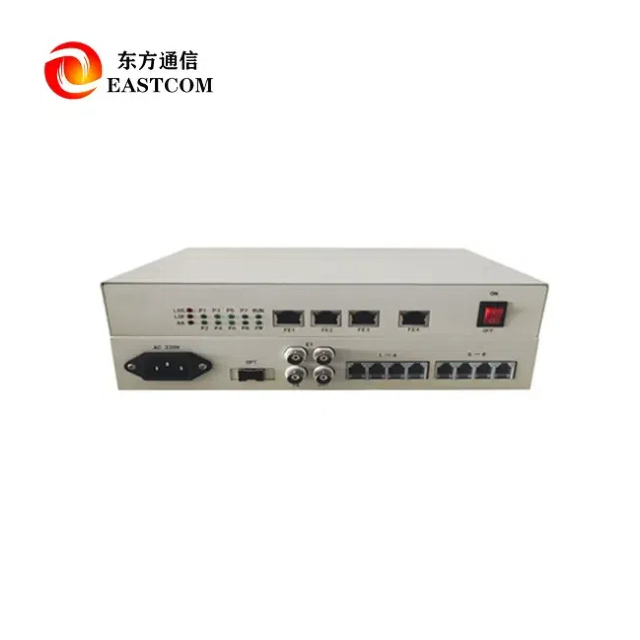
The flexibility of telephone optical transceivers makes them suitable for a wide range of deployment scenarios. In last-mile applications, service providers use them to deliver reliable analog voice services to customers who are too far from central offices for copper. For enterprises, they are useful in extending PBX systems to remote branches without installing separate switching equipment.
Another example is in satellite or remote stations, such as offshore platforms, mines, or military bases, where copper cabling is impractical or vulnerable. Fiber optic links with telephone optical transceivers ensure voice channels remain stable over long distances and under harsh conditions.
To ensure successful deployment, telecom engineers must test the full circuit. Key items include:
Signaling: Verifying that FXO/FXS signaling is functioning correctly, with dial tone, ring, and call progress tones intact.
Echo: Ensuring echo levels are within acceptable limits, as improper impedance matching can cause poor call quality.
Impedance: Matching the transceiver’s impedance to the connected telephone equipment to prevent reflection and noise.
Power: Confirming that FXS ports provide the correct loop current and ring voltage, especially over longer runs.
A structured testing process ensures the system is not only operational but also delivers consistent call quality.
When selecting a telephone optical transceiver, the starting point is understanding the interfaces needed. How many FXO and FXS lines are required? Are RF channels part of the design? Will the deployment involve point-to-point or multipoint distribution?
Other factors include latency, which can impact real-time call quality, and power consumption, which may be critical in remote stations powered by generators or solar. Vendor support is also important; telecom projects often require custom interface mapping, firmware updates, and troubleshooting guidance.
Shandong Dongfang Communication Technology Co., Ltd. specializes in supplying telephone optical transceivers that address these concerns. With in-house design and manufacturing, the company ensures consistent quality and full compatibility with telecom requirements.
A common challenge in deployment is ensuring FXO and FXS pairs are correctly matched and tested. Dongfang’s telephone optical transceivers are engineered with clear interface mapping, intuitive port labeling, and built-in diagnostic indicators that simplify installation. This minimizes errors, reduces deployment time, and ensures signaling integrity.
By providing high reliability and user-friendly features, Dongfang’s solutions give telecom engineers confidence when extending voice channels across fiber. From last-mile delivery to specialized RF applications, these modules streamline projects and deliver consistent performance.
A telephone optical transceiver is more than a niche device — it is a critical component for extending voice and RF channels across modern fiber infrastructure. For telecom providers and system integrators, choosing the right optical transceiver means ensuring compatibility, reliability, and long-term support. Shandong Dongfang Communication Technology Co., Ltd. offers a comprehensive product line designed to simplify FXO/FXS pairing, support RF over fiber, and deliver dependable voice connectivity across challenging environments. To explore solutions for your project, contact us today for interface mapping and a free consultation.


